

This Carers Week, I'm writing three pieces about movement — one for the person receiving care, one for the person doing the caring, and one for both. This is 3. You can find the others on my blog.
Caring relationships contain a kind of intimacy that most people outside them don't fully see.
They hold a great deal of love — and also a great deal of weight. Of shifted roles that nobody quite rehearsed for. Of mornings that require more planning than they used to. Of the moment when someone you've always known as strong needs something from you that they've never needed before.
And movement, in that context, can quietly become one more thing that happens separately. The person receiving care does what they can, when they can. The carer fits something in — when there's a gap, when they remember, when the guilt of doing something for themselves feels manageable.
But what if it didn't have to be separate?
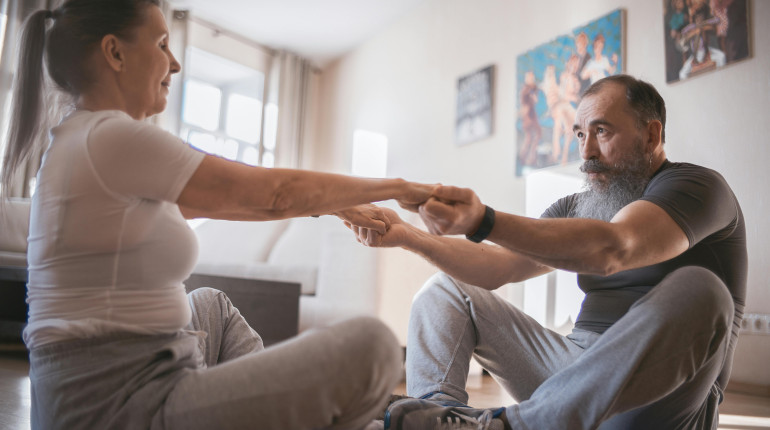
What if ten minutes of gentle, unambitious movement — nothing that looks like a workout, nothing that requires particular fitness — was something you did side by side? At whatever pace works for both of you, with no goal other than that your bodies needed it and your shared time could hold it?
This Carers Week, that is what I want to talk about.
The evidence for movement and physical health is strong and well-established — and I've written separately about what it does for people receiving care, and what it does for carers specifically. But shared movement does something additional that solo movement can't quite reach.
Research on social connection and health outcomes consistently shows that shared physical activity reduces feelings of isolation, improves mood, and supports a sense of agency — the feeling that something is happening on your terms, together.¹ For older adults specifically, loneliness is associated with significant health risks, and shared activity is one of the most consistently effective interventions.²
But beyond the evidence — and I want to say this plainly — shared movement changes something in the dynamic between two people that is harder to quantify but easy to recognise.
For the person receiving care, moving alongside someone else — rather than being observed, assisted, or supervised — shifts the quality of the moment. It isn't "being helped." It's doing, together.
For the carer, movement alongside their person is one of the few moments in the day when the roles soften. You're not supporting. You're not anticipating the next need. You're both just there — moving. Something about that matters more than I can fully articulate, and most carers who try it know exactly what I mean.
Shared movement doesn't need structure, or choreography, or a plan.
It can be one song on the kitchen radio — both of you moving to it however you can. It can be a slow walk to the end of the road and back — not fast, not far, just out. It can be sitting side by side and slowly circling your ankles, rolling your shoulders, reaching both arms overhead and back down. It can be standing at the kitchen counter together and rising onto your toes, ten times, for no reason except that it's good for both of you and you happen to be in the same room.
Every single one of those counts. Every one does something to the body. And every one does something to the space between you that is worth more than I can measure.
One of the things that stops people from trying to move together is the assumption that their needs are too different — that one can stand and the other can't, that one's pace is slower, that the options available to one feel somehow out of reach for the other.
Adaptation is everything here. The same movement, done simultaneously in two different versions — one standing, one seated. A walk at the pace of whoever moves most slowly, with that pace treated not as a compromise but as the actual pace. A breathing exercise that works for every body in every condition, because breath belongs to all of us.
There is always a version. There is always a way in. My work as an exercise referral instructor is built entirely on finding that version — and I promise you it exists, wherever you're both starting from. No body is too limited. No starting point is too small.
If you're reading this as someone who gives care — or as someone who receives it — or as someone quietly doing both at once — I want to leave you with one small, concrete invitation.
This weekend, find one shared movement moment. Just one. It doesn't need a name, or a structure, or a plan. It just needs to happen with someone else in the room.
Because movement is an act of care. And care, sometimes, is choosing to move.
If you'd like to know more about how to start — for yourself, for the person you care for, or for both of you — I'd love to help you find a way in.