

Posted: 15th July 2026
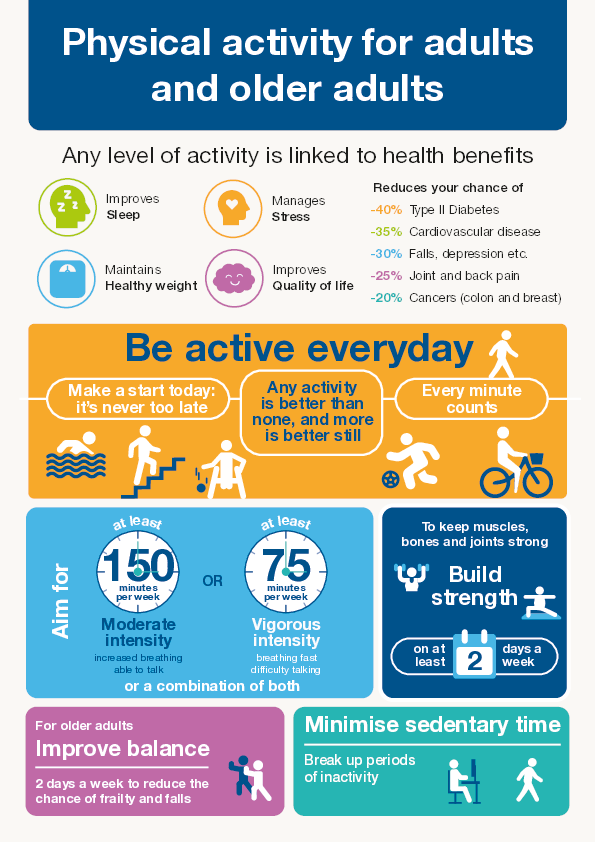 If you've been following me for a while, you'll know I don't get excited about fitness trends. But two things landed this year that I really think are worth five minutes of your time - not because they're flashy, but because they're reassuring. One is from the UK's Chief Medical Officers, who refreshed the national physical activity guidance in July, doubling down on their previous advice issued in 2019. The other is from the American College of Sports Medicine, who updated their strength training guidance in April - their first update in 17 years.
Different documents, different countries, different focus. But put them side by side and they're telling us the same story, and it's a kind one.
For years, a lot of fitness advice has suggested that there's a correct way to move — the right number of sets, the right kind of weights, the right level of intensity, pushing to the point where you can't do another rep. The new CMO guidance isn't radical at all - in fact, much of the advice remains the same as previously given, but the evidence for physical activity as a means of supporting physical and mental health has got stronger.
The update, and the emphasis it places on time, intensity and type of exercise, simply cuts through the noise created by parts of the fitness industry, the media and well-meaning social media influencers who'd have you believe that if you're not giving 110%, it's not worth bothering. So, if you've ever felt like you were doing it wrong, or that you didn't know enough to start, I want you to hear this clearly: the actual evidence doesn't support that at all.
The strength training review looked at 137 studies covering over 30,000 people, and one of its clearest findings is that things like equipment type barely matter. Bodyweight moves, resistance bands, dumbbells, machines all produce real, measurable improvements in strength and how well people can move through daily life. What mattered most was showing up and putting in reasonable effort, not the tool in your hand.
And you don't need to push yourself to exhaustion either. The research found that training to the point of total failure doesn't produce better results than stopping a little before that point. So if you've ever avoided strength work because it sounded brutal, punishing and not for people like you, I am here to tell you that's you’re exactly the kind of person who can get the most benefit.
Both reports agree on something I say to clients all the time: the biggest jump in health benefit happens when someone goes from doing nothing to doing something. Not from someone who's already active becoming slightly more active. From nothing to something.
That's a big deal, because it means the hardest part — starting — is also where you get the most reward. You don't need to hit a perfect number to begin to see it. The general guide is still around 150 minutes of movement a week, and twice-weekly strength work, but (and this is really important, especially if you are approaching more mature years) that target is something to grow into, not a bar you need to clear before it counts.
Both reports put real weight behind something that doesn't always get talked about enough — strength and balance work. The CMO guidance highlights it specifically for people getting older, and for anyone on GLP-1 medications for weight management or diabetes, because keeping your muscle strong matters even more while your body is changing in other ways, whether that’s through natural ageing processes or pharmaceutical interventions to help you achieve better health.
The research backs this up with things that actually matter in daily life, not just gym numbers — how fast you can walk, how easily you can get up from a chair, how steady you feel on your feet. All of these improved with regular strength work, even in people who'd never done any before. If you've ever wondered whether standing up from a chair a few extra times a day "really" counts as exercise — it does, and it's genuinely one of the better things you can do for yourself. I know I sound like a stuck record when I encourage sit to stands, but there is a good reason for it, I promise.
I know some of you have been told to "be more active" by a GP or physio and had no real idea what that meant in practice, or worried that moving more might make things worse. The evidence here is very reassuring. Looking at large groups of people, including thousands of older adults, strength-based movement didn't increase the risk of anything serious. For most long-term conditions, the benefit of moving, and of increasing strength outweighs the risk.
That doesn't mean every type of movement is right for every condition, which is exactly why working with someone who understands your situation matters. But it does mean the starting point isn't "should I move at all" — it's "what's the right way for me to start."
In practice, this is exactly how I already work with clients — starting wherever you are, using whatever equipment feels right for you, building up strength and balance gradually, and never chasing exhaustion for its own sake. If any of this has made you curious about where you'd fit into that picture, I'd love to talk it through with you. Please feel free to reach out if you have any questions, or would like any advice on how to start.
Sources: UK Chief Medical Officers' Physical Activity Guidelines, refreshed July 2026. Currier BS, D'Souza AC, Fiatarone Singh MA, et al. "Resistance Training Prescription for Muscle Function, Hypertrophy, and Physical Performance in Healthy Adults: An Overview of Reviews." Medicine & Science in Sports & Exercise 58(4):851-872, 2026.