

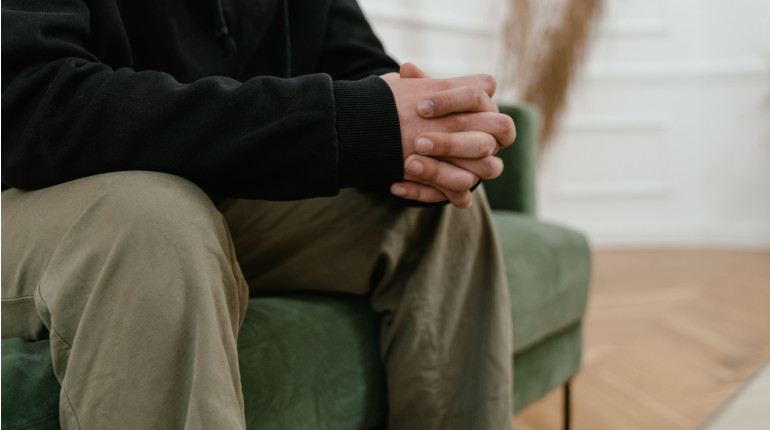
This Carers Week, I'm writing three pieces about movement — one for the person receiving care, one for the person doing the caring, and one for both. This is part 2. You can find the others on my blog.
You probably haven't thought much about your own body this week.
If you're an unpaid carer — a partner, a parent, an adult child, a sibling, a friend who quietly stepped up — you already know what I mean. There is always someone else to think about first. Always something that needs doing before you get a turn. Always a reason why your own wellbeing goes back to the bottom of the list.
This Carers Week, I want to talk about you. Your back. Your shoulders. Your hips that ache by the end of a long day. Your sleep, which hasn't quite been right in longer than you care to admit. Your nervous system, which has been absorbing far more than it was designed to carry alone — quietly, without complaint, because that is what you do.
I'm not going to tell you to rest more. I know that's not realistic. I'm going to tell you something that might actually help.
Caring is physical work. Invisibly so — at least to anyone who isn't doing it. There's the supporting, lifting, guiding, bending, reaching. The hours spent in hospital chairs or beside beds. The posture that develops from constant vigilance: rounded shoulders, a chin that juts forward, hip flexors chronically shortened from long periods of sitting in places you'd never choose.
Research consistently shows that unpaid carers are at significantly higher risk of poor physical health than non-carers — not because caring breaks people, but because carers so rarely carve out space to protect themselves.¹ Musculoskeletal problems are among the most commonly reported — the back, the neck, the knees — alongside fatigue that sleep alone doesn't fully resolve.
The body keeps score. Not dramatically, not all at once — but slowly, in the accumulation of strain that never quite gets released, the tension that never fully unwinds.
Here's something most carers already sense but rarely hear put plainly: the more depleted you are, the more you need to move — and the less capacity you feel you have to do it.
This is the movement paradox. And it's real.
Because movement does take something. But it also gives something back that nothing else does. Not the high-energy, euphoric version fitness advertising promises — the quieter, more functional kind. Better circulation. Regulated stress hormones. Muscular tension that actually releases, rather than sitting in your body until it becomes pain. A nervous system that has been given a brief, valuable signal that it is supported.
Even short bursts of movement — two or three minutes, several times through the day — create measurable physiological change.² This isn't a case for doing nothing longer than a workout; it's a case for not waiting until you have a full hour before you start. You almost certainly don't have a full hour. But you almost certainly have two minutes.
This isn't about fitness in the conventional sense. It's not about targets, or programmes, or transformation.
It's about giving your body the minimum it needs to keep doing what it's doing without breaking down. Movement that addresses the specific physical patterns of caring work — the forward pull through the upper back and shoulders, the compression in the lower spine, the shortened hip flexors. Movement that helps regulate a nervous system under sustained load. Movement that tells your body it matters too.
That might look like a deliberate stretch while the kettle boils. It might look like walking to the end of the road and back — alone, briefly, in your own company. It might look like a few minutes of intentional breathing before you go to sleep, or a gentle shoulder release before you go back in.
None of this is dramatic. All of it counts. And the evidence for this kind of low-intensity, distributed movement for people under chronic stress is strong and consistent.
"I feel guilty spending time on myself." I understand that. I also want you to consider this: sustained caring requires a body and a nervous system that can sustain it. Movement isn't selfish. It's maintenance. It's how you stay.
"I'm too tired." I know. This is where I'd gently distinguish between fatigue — which is real and valid — and the kind of tired that gets worse when you stay still. For many people, a short, gentle movement break reduces tiredness rather than adding to it. Not always. But often enough to be worth trying.
"I'll do something about it when things settle down." Things often don't settle down. Which is exactly why small, woven-in-to-your-day movement matters more than waiting for a perfect window that may not arrive.
I want to offer you something that may feel unfamiliar: permission.
Permission to include yourself in the people worth looking after. Permission to take ten minutes — not because you've earned it or because things have settled, but because it is how you stay well enough to keep doing what you do.
You don't need a gym. You don't need a class. You don't need to block an hour.
You just need a moment. A stretch when the kettle boils. A walk to the end of the road. A few deep breaths before you go back in.
It matters. You matter.
If you'd like support with this — a starting point that fits your actual life, not an ideal version of it — feel free to drop me a message. No pressure. No judgement. No expectation that you arrive anywhere other than exactly where you are.