

If you had to guess which pillar of healthy ageing you're quietly neglecting right now, which one would it be?
For most of us, it's not that we're doing everything wrong. It's that life gets busy, and one or two things slip - usually the ones that don't shout for attention. Strength training doesn't send you a reminder. Neither does sleep, or the friend you haven't called in a month. But research is increasingly clear that healthy ageing rests on five interconnected pillars: strength, movement, nutrition, social connection, and sleep. Neglect one for long enough, and the others start to suffer too.
Here's what the evidence says about each - and why, if you're looking for one place to start, group Pilates can help more of these than you might expect.
From your 30s to your 60s, the body loses roughly 250g (5-8%) of muscle a year - and after 70, that loss accelerates to around 15% of muscle mass per decade, according to Mersey Care NHS Foundation Trust. While it is normal to lose some muscle as you age, sarcopenia - the loss of muscle mass and strength that goes beyond what's expected with normal ageing - can meaningfully affect how easily you move through daily life, and is one of the biggest drivers of lost independence later in life, affecting everything from carrying shopping to getting up off the floor unaided.
The good news is that resistance and strength work at any age can help preserve muscle mass and function. It's never too late to start, and it's rarely as demanding as people fear.
Regular physical activity in later life helps improve health and reduce the risk of heart disease and stroke, and the NHS's physical activity guidelines for older adults point to strength, balance and flexibility work as protective against falls specifically. Movement also helps to release tension held in the body, and in doing so acts as a natural pressure valve for stress.
The key word is regular - consistency matters more than intensity, especially for people returning to movement after a long break or managing a long-term condition. It’s not how hard you push yourself (but you should aim to get a little out of breath), or how long for, but the fact that you move often, even if that’s small chunks throughout the day. Long periods of inactivity are known to be detrimental.
Nutrition isn't my area of expertise, and I’m not claiming to be a nutritionist. But the big-picture principles are worth knowing: protein intake plays a meaningful role in supporting muscle health as we age, and the Royal Osteoporosis Society is clear that calcium, vitamin D, and weight-bearing or resistance exercise work together to protect bone density - none of the three does the job alone. Good hydration also supports joint health, and diet plays a role in how the body manages stress.
None of this usually requires a massive overhaul - just an awareness of where the gaps might be, and a conversation with a GP or registered dietitian if you want specific advice tailored to you.
The impact of loneliness and isolation on mortality is comparable to well-established risk factors like obesity, and has a similar influence to cigarette smoking. This is according to the Campaign to End Loneliness, which also links loneliness to raised blood pressure and reduced immunity. Consistent social connection is also one of the most reliable predictors of whether people stick with a movement routine long enough to feel the benefit of it.
This is why where you move can matter as much as how - a class you look forward to attending is more sustainable than a routine you do alone and dread. And the excuse to have a natter and coffee afterwards can do wonders for your mood too.
Sleep isn't downtime. It's when the body carries out essential repair and maintenance - and it has a close, two-way relationship with stress. Regular physical activity and exercise improves your body and mind, and it can also help you sleep better, according to NHS Every Mind Matters - even small amounts of movement, built up gradually, can make a difference if you are starting from an inactive lifestyle.
Movement is one of the most consistently evidence-supported ways to improve sleep quality, which makes it one of the more accessible levers available if sleep is the pillar you're struggling with.
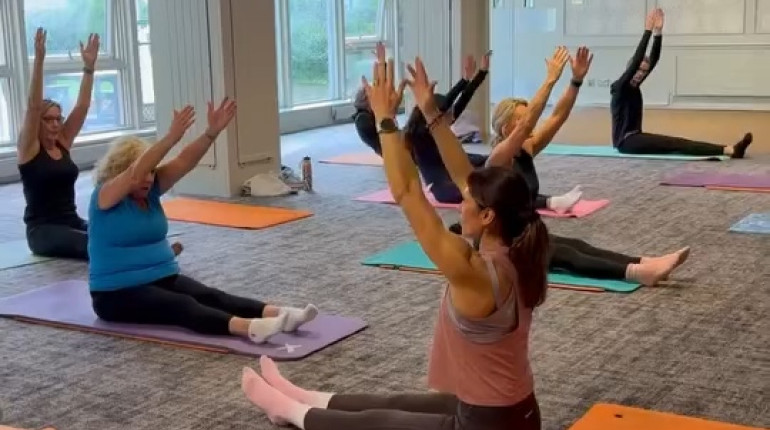
Obviously no single class can replace a GP, a dietitian, or a good night's sleep. But group Pilates sits at a useful intersection of these pillars: it builds strength through resistance and controlled, loaded movement; it delivers functional movement patterns that support daily life; it happens in a room with other people, which is where the social-connection benefit comes from almost by default; and regular movement of this kind is linked to better sleep quality over time.
It's not a replacement for thinking about all five pillars individually. It's a reasonably efficient place to start if you're not sure where to begin.
If you're new to Pilates classes, there's a welcome offer waiting: your first 3 classes for £18. Come and see which pillar it ends up supporting most for you.

